I’m talking about my large-scale data systems column, System Daily Notes — someone once asked, after reading your column articles, it might be a long time before they get used they never get used at all, so why buy? Besides, umbrellas are a must-have on rainy days, but this column certainly isn’t during an interview. So this really isn’t a good “business” — narrow audience, low-frequency use cases, multiply the two, and you get my dismal sales.
That’s also why successful columns rack up tens of thousands of purchases, while I only sold a measly 250 and yet dare to share my experience. If you happen to have similar dangerous ideas, this might serve as a reference.
Author: Muniao’s Miscellany https://www.qtmuniao.com/2024/04/08/paywall-one-year. Please credit the source when reposting.
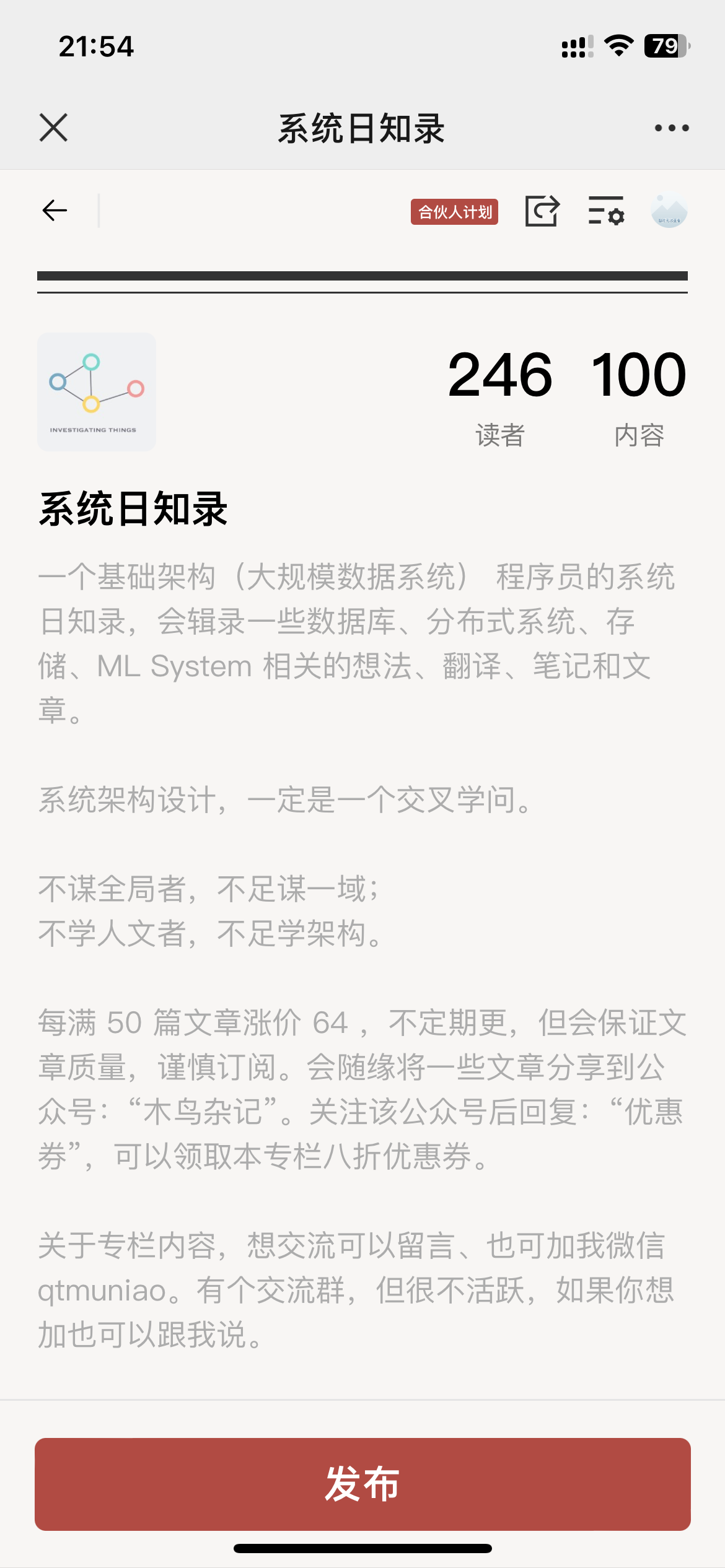 IMG_8300.PNG
Why Is This So Hard?
There are both external conditions and internal factors.
Objectively speaking, the audience for a technical column is too small. Trying to sell “second-hand knowledge” to the group of people who most advocate open source, love sharing, and are most capable of self-learning? That’s a pipe dream. Besides, compared to a paid column (or newsletter), people prefer a complete, full-fledged course.
Subjectively, the column’s content is too scattered. Naturally, I have my arguments: broad data systems, or large-scale data systems, are inherently all-encompassing; being a bit scattered early on is to test user feedback and find a direction, and so on. So, did you get any feedback? Any at all? Let’s just say it’s better than nothing, but it doesn’t form statistical value, so naturally it can’t guide the output direction. Without focus, you can’t solve pain points. Half sun-shading, half waterproof, plus a cute umbrella charm — tell me, who would buy this umbrella?
So How Did I Sell 250?
The channel that sold the most was, surprisingly, tweeting. One day I discovered that posting article summaries on Twitter actually drove conversions and even gained followers. Overall, Twitter users have relatively strong willingness to pay. Of course, getting my Twitter account through the initial cold-start phase to 1k followers (which really isn’t much in the self-media world) was thanks to friends’ enthusiastic retweets. In contrast, my 12k followers on Zhihu barely converted at all. Speaking of Zhihu, I feel its short-message section similar to tweets — “Ideas” — never really took off. I don’t know whether it’s because the DNA of starting with long articles makes it awkward, or because it’s not the “favored child” so they don’t give it traffic.
Speaking of traffic, Zhihu started with a waterfall feed of people you followed, but after taking off, it decisively hijacked recommendations with algorithms. I understand platforms need to make money, but at least make some money — the stocks I bought are still weighing down my portfolio! When I first started writing, I also got a lot of positive feedback from Zhihu. Back then, writing on Zhihu was deterministic — as long as you wrote with care, the platform would push it with care, and people would like it with care. But now that certainty is gone; traffic is random, users are passive. And Zhihu’s algorithm “vibe” is quite hard to guess — or rather, no one bothers to guess — after all, it’s the hardest platform to monetize, bar none. Its original commitment to content quality is long gone, truly caught between a rock and a hard place. So my output on Zhihu has decreased too. It’s easy to get worked up about Zhihu, but I digress.
The second-best conversion channel is Moments. This is mostly thanks to my DDIA sharing sessions (it’s truly a good book, in several senses). Many people added me on WeChat through these sessions. Every time I finish a column article, I post it on my Moments. Over time, perhaps out of appreciation for my DDIA sharing, people gradually threw me some subscriptions. I can’t help but sigh: DDIA is a great book, short on details but strong on framework, connecting and verifying ideas with sweeping breadth. I recommend it again to anyone who wants to build a knowledge system for data systems. Of course, it pairs even better with my “DDIA Chapter-by-Chapter Deep Reading” (search that keyword on Google and the first result is it).
The remaining scattered channels, including WeChat Official Accounts, Bilibili, Zhihu, Xiaohongshu, and V2EX, are just a handful here and there, not at scale.
After channels, let’s talk about other growth strategies. One is sending out discount coupons at specific times after the platform launched them; this converted many who had been following but hadn’t pulled the trigger. Another was switching the column from subscription to one-time purchase, which lowered the psychological purchase barrier for some. Also, occasionally I’d find angles on topics — for example, people are quite interested in interviews, so I’d write more about that.
Bit by bit, over one year, these added up to nearly 250 seed users.
Why Did I Start This Column?
After all this, let’s revisit the original intention — why did I start this column in the first place? Early last year, by chance, I learned about the “Xiaobot” platform and the newsletter culture it promotes. At the time, I thought its color scheme was great (but the code formatting was so ugly! And I was the one who gave feedback to get it added, which also shows how few programmers were using the platform back then). Making some money with words felt so cool.
It’s like a message queue — through such a column, you can decouple the producer (me) from the consumer (readers) — I just focus on creating, and don’t have to worry about readers… right? How could that be — you have to promote it yourself! Because the platform design is decentralized; it doesn’t even have an official column hub page (though third parties do this). But this restrained tone does have a kind of forest-like beauty.
So, I gradually shifted my creative focus from Zhihu to Xiaobot. What to write about? Naturally, the Feynman technique — write about what you’re learning. Just like the “build in public” practice, this is essentially “learning in public” — right? A paid column seems more like private, although I occasionally share some articles on public platforms when the mood strikes.
With this little whip cracking, over this past year plus (I checked — first article was published at the end of February 2023), I actually wrote 100 articles. Counting on my fingers, that’s nearly two per week? Truly beyond imagination — how could a lazy person like me have such “self-discipline”? So, do you know how thin-skinned people stick to something? Sell air, ah no, sell promises. Once you take money, you’ll be pushed forward. Although, after switching from subscription to one-time purchase, I also felt relieved and let out a long breath, no longer promising weekly updates. After all, I’ve tested my capability boundary, and two articles per week is clearly outside that boundary.
What’s Next?
After this year of haphazard exploration, going forward — I still won’t converge. After all, the meaning of life lies in finding incremental gains; how could one converge to an interval? Next, due to work and interest, I might write more about AI systems. But the old sections: storage and databases won’t be neglected either; plus, interview topics — after all, they’re the traffic password — will also be updated regularly. As for what else to write, that depends on our dear readers’ “feedback.”
Oh, right, I should also put more effort into fundamentals. Because a few days ago I came up with a slogan — “Technology is more than CRUD; developers need underlying logic” — and it worked pretty well. After years of work, many concepts that seemed complex in college now reveal their harmony and simplicity. So I’ll combine my work experience over the years, return to basics, and reshape the fundamental knowledge system from college, to provide ammunition and sustenance for those anxious about “working for so long, yet feeling like they’re standing still.”
After rambling for so long, I can’t hold back my ten-meter-long sword any longer — it’s time to reveal my true intention — 100 articles, time for a price hike, dear sirs, don’t miss it as you pass by, please subscribe. Right now it’s “negotiable” — follow my WeChat Official Account: Muniao’s Miscellany, reply “coupon” for a 20%-off subscription link. Limited quantity, gone when they’re gone.