🚀 About Me
I am Qingteng Muniao, a programmer focused on large-scale data systems. I enjoy reading, writing, sharing, badminton, and photography. Qingteng is taken from Xu Wei’s pseudonym, and Muniao is derived from my real name. To briefly introduce my background: I hold a Bachelor’s and Master’s degree in Computer Science from BUPT (Beijing University of Posts and Telecommunications). I’ve worked at foreign enterprises (Microsoft), big tech (Tencent), former unicorns (Megvii), and startups (NebulaGraph). My past experience has been mainly focused on large-scale data systems: distributed data processing, massive object storage, distributed graph databases, AI Platform, and other directions. You can get a rough idea from my article topics and shared content.
You can find me on LinkedIn, Bilibili, Zhihu, Twitter, WeChat (qtmuniao), and my WeChat Official Account (Muniao’s Miscellany).
People live a lifetime, leaving traces like geese passing by. I hope these words can record some traces of my thoughts on life. If they are helpful to you, please leave a comment to encourage me.
Welcome to follow my WeChat Official Account: “Muniao’s Miscellany”. Reply with “resources” to get a comprehensive list of books, open courses, and blogs on distributed systems and databases that I have compiled.
 wx-distributed-system-s.jpg
For more articles on distributed systems, welcome to subscribe to my paid column, which is also a newsletter. I recommend subscribing via email rather than WeChat: “System Daily Notes”
 poster 1.png
💼 Technical Focus
In high school, I accidentally stumbled into informatics competitions, but the connection ended after just a few classes. I couldn’t understand the difference between Pascal’s assignment operator and the equals sign in equations, which is what they call “not getting it.” The experience was so short that I even forgot I almost did competitions.
Yet, in college, I accidentally entered the Computer Science department. Every time I think about it, it must be fate. In my freshman year, when I first started learning C language, the assignment operator no longer seemed like a problem. As I spent every weekend staying up all night doing homework, I gradually got the hang of it. Starting from figuring out the “diamond pattern,” I gradually made coding my livelihood.
Now I focus on distributed systems, distributed storage, databases, and other large-scale data system directions. My main work experience involves large-scale data processing, object storage, graph databases, and other directions. This blog is mainly used to share some experiences and ideas in the above fields, paper reading guides, code reading notes, book notes, and so on.
If you have similar interests, want to consult, or have job opportunities or entrepreneurial opportunities, feel free to add me on WeChat (qtmuniao) to chat. But sometimes I reply slowly, please forgive me.
📖 Projects and Works
Here are some things I’ve done, hoping they will be helpful to everyone:
Shijing Wushi
I’ve always felt that the Book of Songs is beautiful—the layered rhythms, the emotions that are either gentle or passionate. When we study the Book of Songs in school, we are told that it extensively uses the “bi-xing” (comparison and allusion) technique. Bi-xing attaches beauty to concrete things—plants, insects, fish, birds, and beasts. Names like reeds, water shield, osprey, peach, and millet bring out the atmosphere, colors, and emotions of the poems. Confucius said “learn the names of many birds, beasts, plants, and trees.” The more I read, the more I feel this saying is simple yet far-reaching.
So I created this website: Shijing Wushi. It does something very simple: it lists as many plants, insects, fish, birds, and beasts that appear in the Book of Songs as possible, with the original text, pictures, modern meanings, and some basic explanations. While making it, I found that although large language models are already very powerful, the details are just too numerous. Limited by time and lack of thorough verification, there are inevitably errors and omissions in various entries, and the pictures are also somewhat careless. So I added a comment function. Welcome everyone to correct and supplement materials, or even just leave your feelings when reading a particular line.
 homepage.png
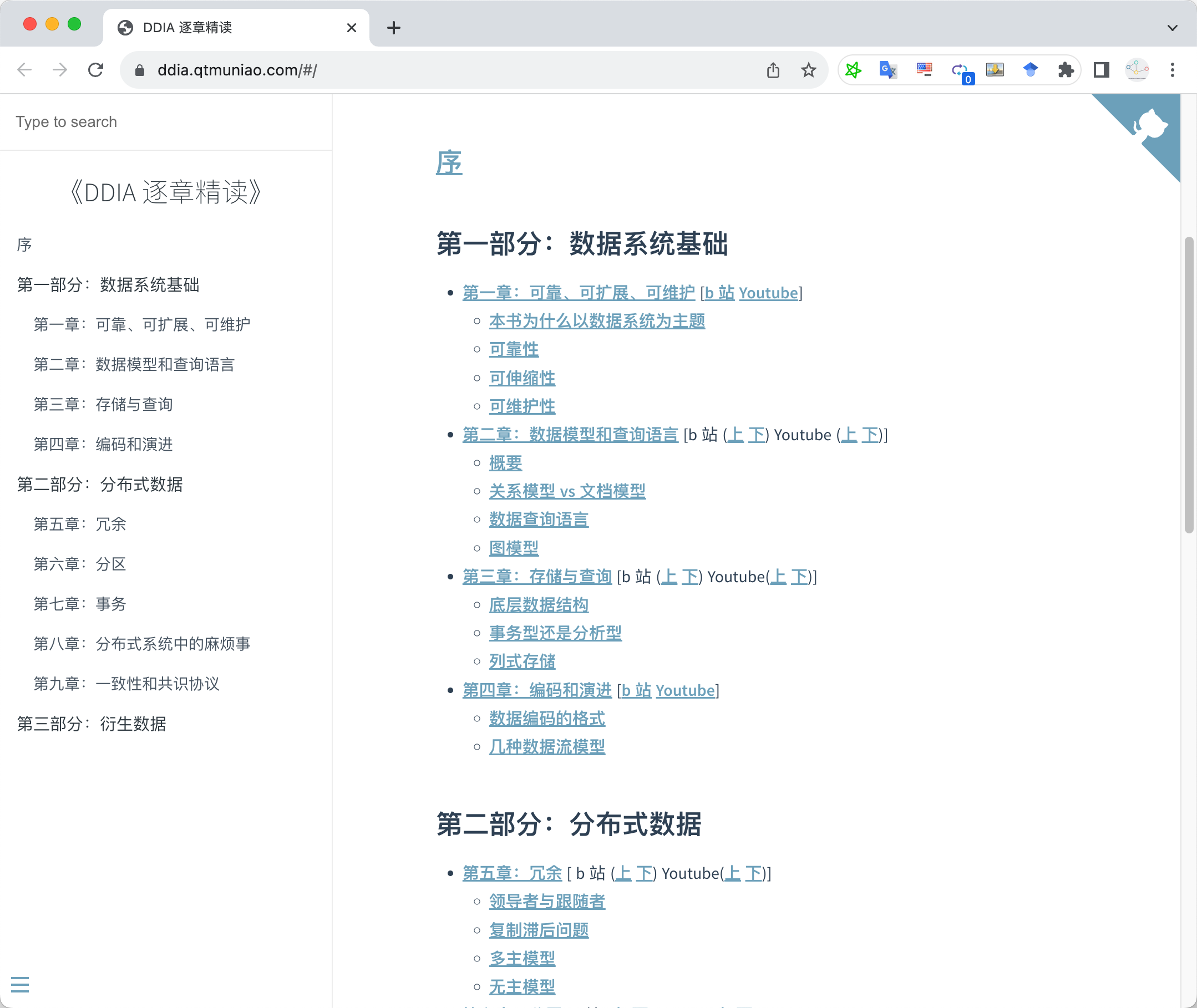
DDIA Chapter-by-Chapter Deep Reading Booklet and Screen Recordings
For Martin Kleppmann’s DDIA, I read each chapter in English roughly twice, then translate it myself, smooth out the wording, and find relevant materials to supplement some background. Then I do several sharing sessions for each chapter, forming screen recordings placed on Bilibili and Youtube. All the manuscripts are compiled into the booklet below. The online version is here, and the PDF version can be downloaded here.
 ddia.png
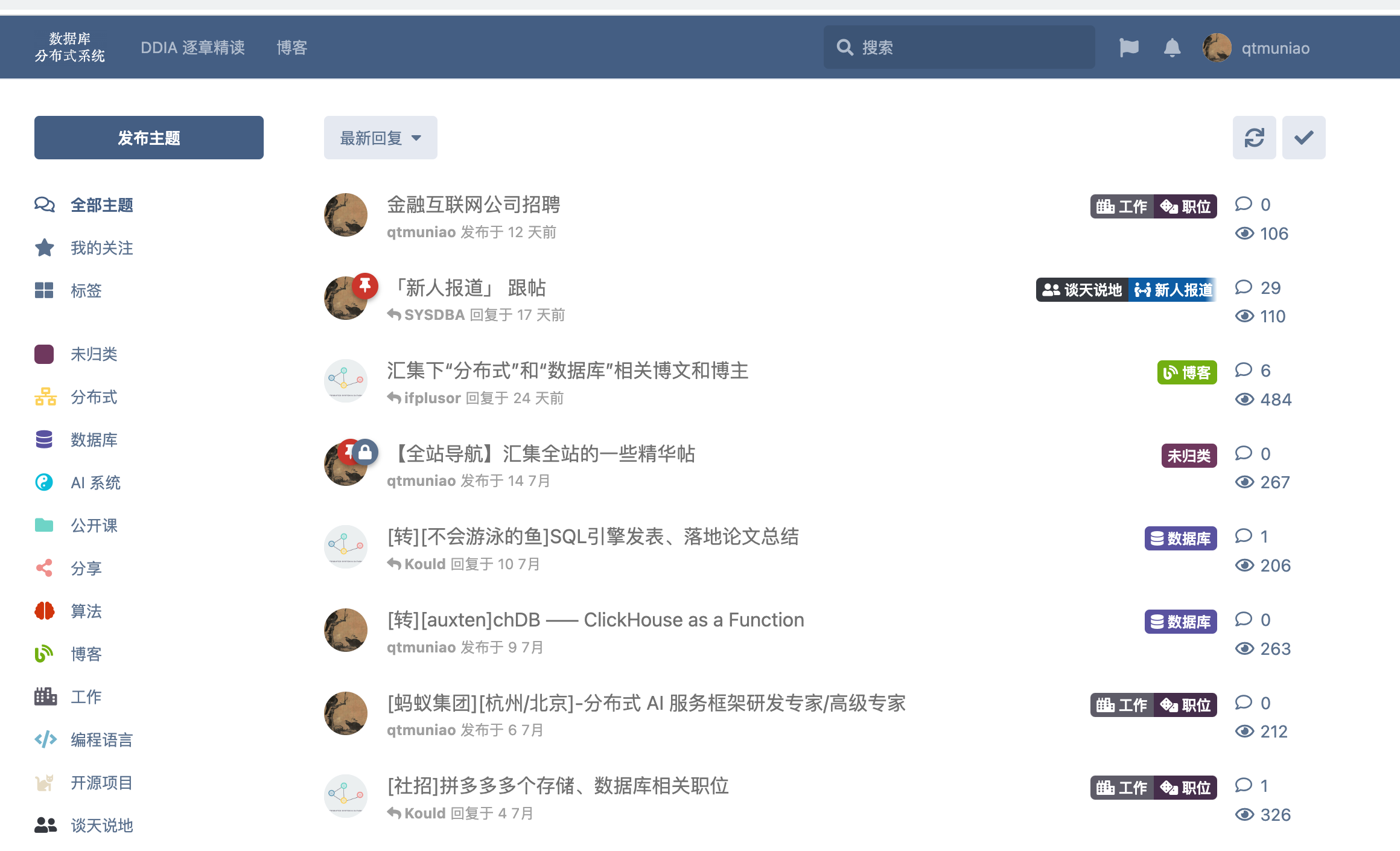
Distributed Systems & Database Forum
A forum specifically for distributed systems and database enthusiasts, with the following sections:
- Jobs & Recruitment
- Databases
- Distributed Systems
- Open Courses
- Blogs
- Open Source Projects
There are many learning materials and relevant positions in various sections. After registering, you can see everyone’s new member introductions and find like-minded friends to exchange ideas with.
 distsys.png
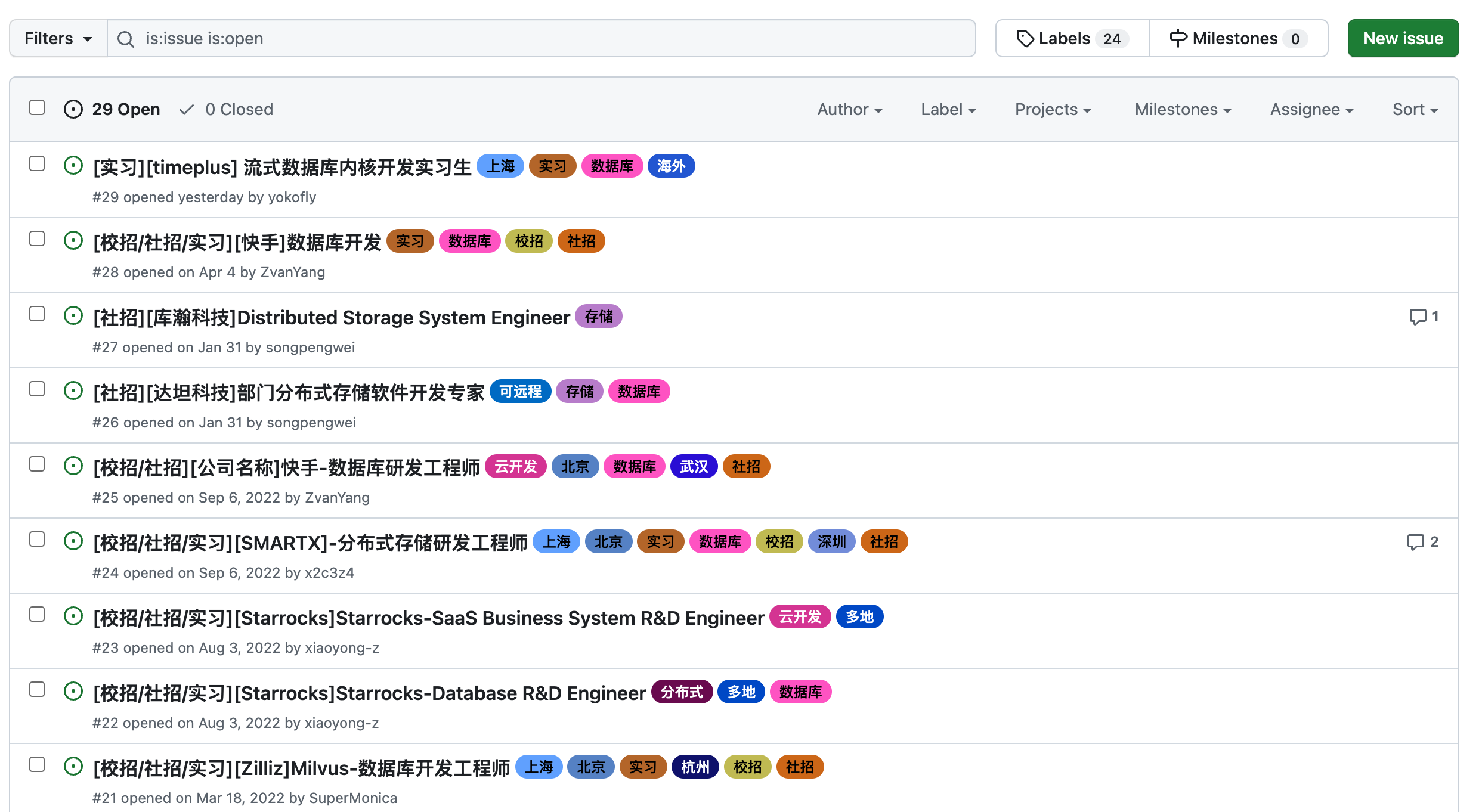
Distributed Systems & Database Job Postings
Posting distributed system, db, storage, and computing related job referrals in the form of (you) submitting issues and (volunteers) labeling them.
 jobs.png
📸 Photography
I’ve been into photography for over a year now (since 2018), still a beginner. My main equipment is Canon 6D and DJI Mavic 2 Pro. I mainly shoot landscapes.
 |
 |
 |
|---|---|---|
 |
 |
 |
 |
 |
 |
 |
 |
 |
For more photos, you can check out my photo album, or visit my 500px and Tuchong.
🏸 Sports
I’ve run a half marathon and cycled through Gaodadong. But what I stick to on a regular basis is just playing badminton and taking long walks in hutongs. Day after day, I remain as unskilled as ever.